Notes
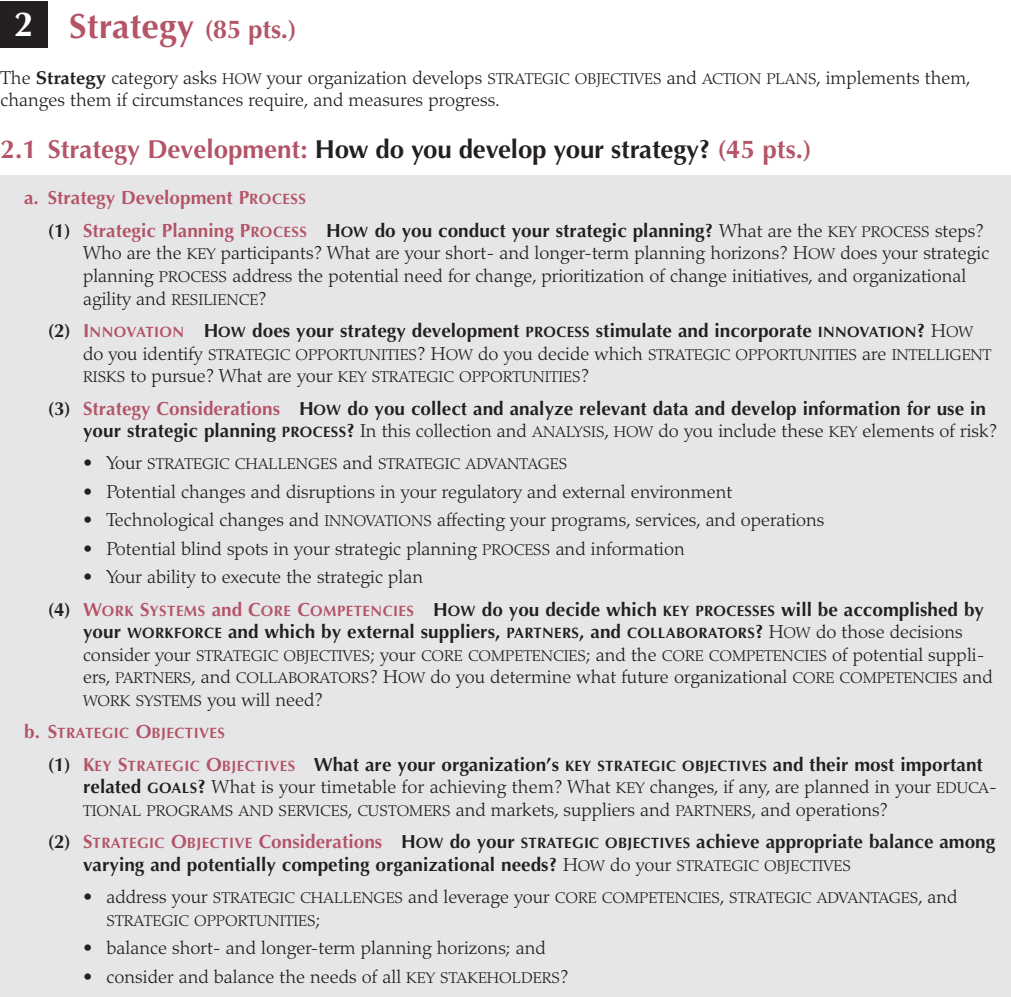
2.1. This item deals with your overall organizational strategy, which might include changes in student and other customer engagement processes and in program and service offerings. However, you should describe the student and other customer engagement and program and service design strategies, respectively, in items 3.2 and 6.1, as appropriate.
2.1. Strategy development refers to your organization’s approach to preparing for the future. In developing your strategy, you should consider your level of acceptable enterprise risk. To make decisions and allocate resources, you might use various types of forecasts, projections, options, scenarios, knowledge (see 4.2b), analyses, or other approaches to envisioning the future. Strategy development might involve key suppliers, collaborators, distributors, partners, students, and other customers.
2.1. The term “strategy” should be interpreted broadly. Strategy might be built around or lead to any or all of the following: new, changing, or discontinued programs and services; changing modalities to support teaching and learning; services to new, changing, and special student populations; definition or redefinition of your role in your organizational ecosystem (your network of partners, suppliers, collaborators, competitors, students, other customers, communities, and other relevant organizations inside and outside the education sector that serve as potential resources); differentiation of your image; new core competencies; acquisitions; new services to improve access, grow revenue, or reduce costs; and new staff or volunteer relationships. It might also be directed toward meeting a community or public need.
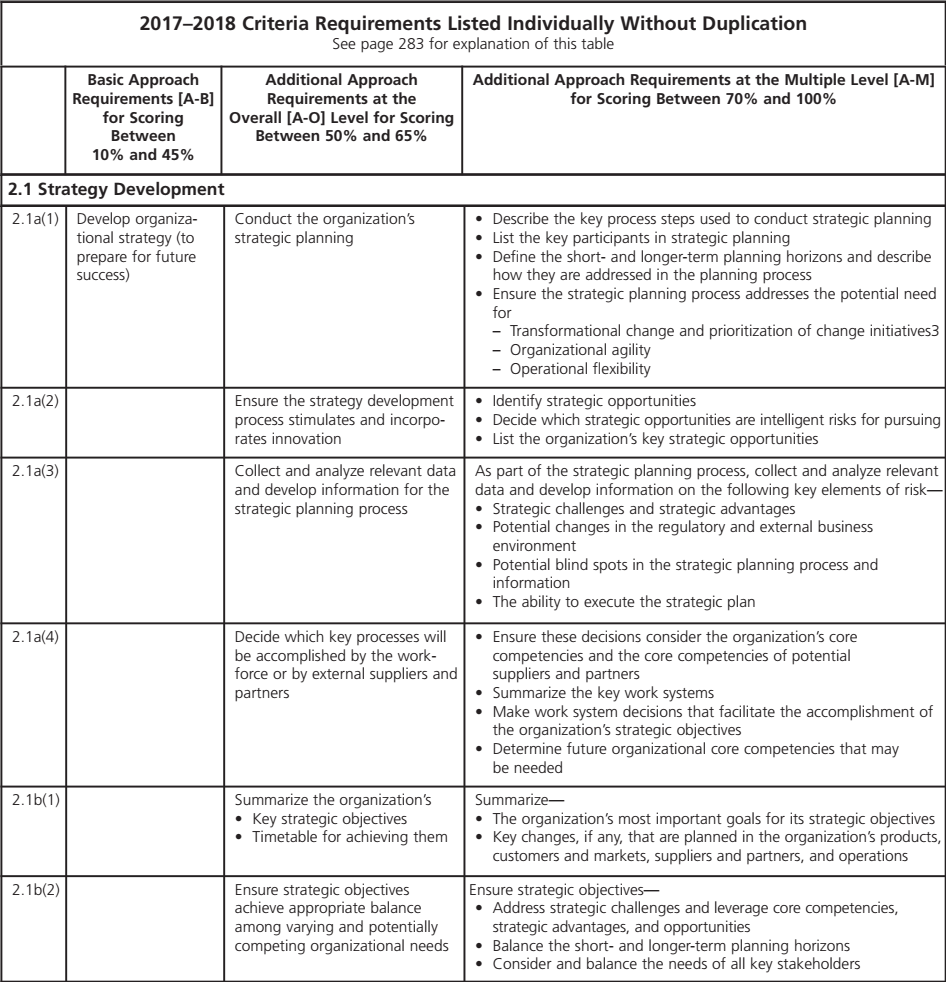
2.1a(1). Organizational agility refers to the capacity for rapid change in strategy and the ability to adjust your operations as opportunities or needs arise.
2.1a(3). Integration of data from all sources to generate strategically relevant information is a key consideration. Data and information might relate to student, other customer, and market requirements, expectations, opportunities, and risks; financial, societal, ethical, regulatory, technological, security and cybersecurity, and other potential opportunities and risks; your core competencies; the competitive environment and your performance now and in the future relative to competitors and comparable organizations; education reform; workforce and other resource needs; your ability to capitalize on diversity, and promote equity and inclusion; your ability to prevent and respond to disasters and emergencies; opportunities to redirect resources to higher-priority programs, services, or areas; changes in the local, national, or global economy; requirements for and strengths and weaknesses of your partners and supply network; changes in your parent organization; and other factors unique to your organization.
2.1a(3). Your strategic planning should address your ability to mobilize the necessary resources and knowledge to execute the strategic plan. It should also address your ability to execute contingency plans or, if circumstances require, to shift strategy and rapidly execute new or changed plans.2.1a(3). Technologies that continue to drive change include enhanced automation, the adoption of cloud operations, the use of data analytics, the Internet of Things, artificial intelligence, and large dataset-enabled business and process modeling.
2.1a(4). Your work systems are the coordinated combination of internal work processes and external resources you need to develop and produce educational programs and services, deliver them to students, and succeed in your market. External resources might include partners, suppliers, collaborators, competitors, and other entities or organizations that are part of your organizational ecosystem. Decisions about work systems involve protecting intellectual property, capitalizing on core competencies, and mitigating risk.
2.1b(1). Strategic objectives should focus on your specific challenges, advantages, and opportunities—those most important to your ongoing success and to strengthening your overall performance and your success now and in the future.