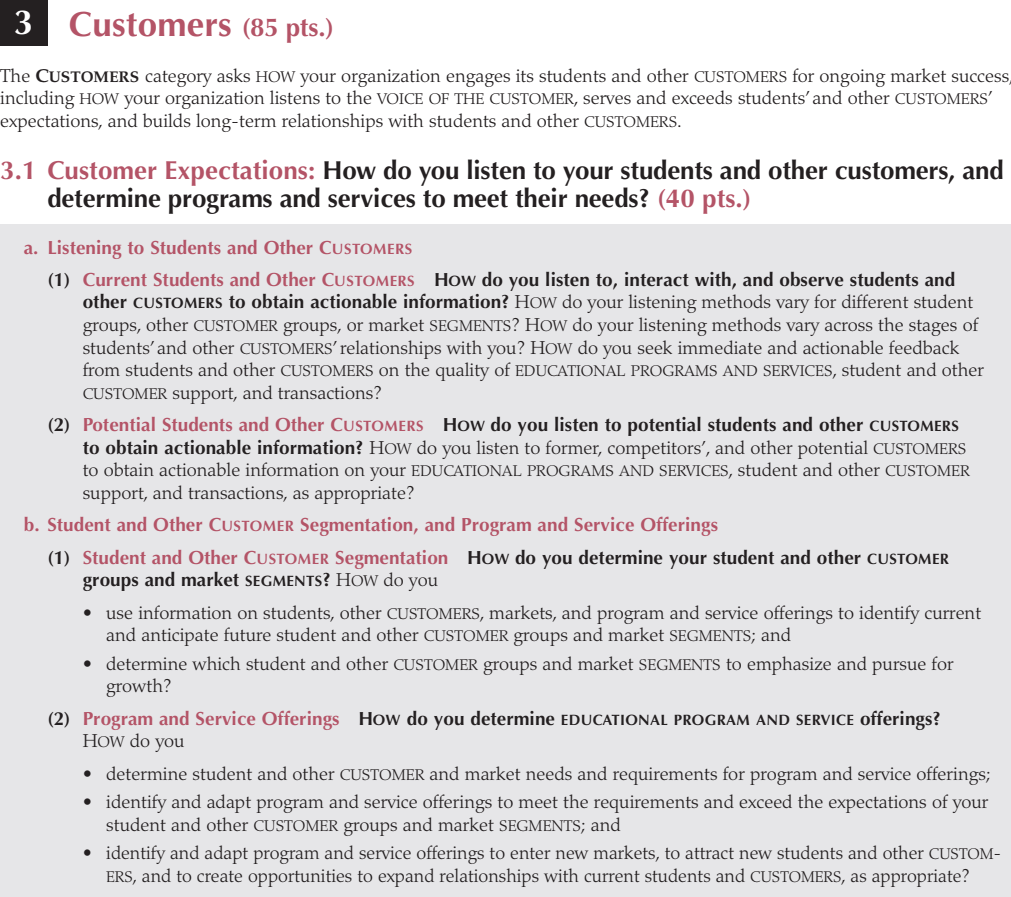
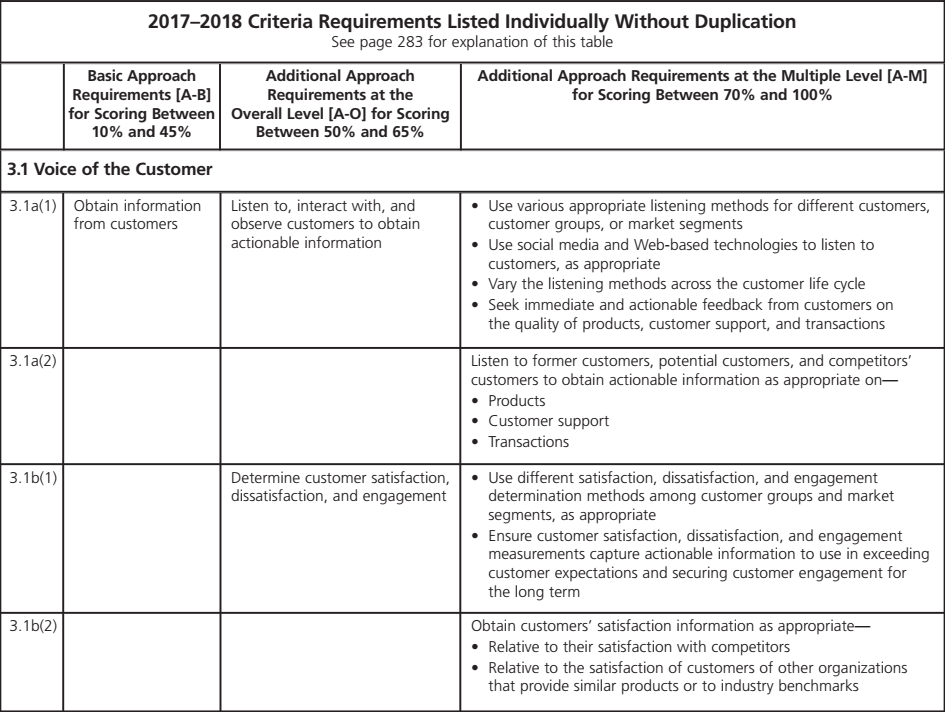
Current Students and Other CUSTOMERS HOW do you listen to, interact with, and observe students and other CUSTOMERS to obtain actionable information? HOW do your listening methods vary for different student groups, other CUSTOMER groups, or market SEGMENTS? HOW do you use social media and web-based technologies to listen to students and other CUSTOMERS, as appropriate? HOW do your listening methods vary across the stages
of students’ and other CUSTOMERS’ relationships with you? HOW do you seek immediate and actionable feedback from students and other CUSTOMERS on the quality of EDUCATIONAL PROGRAMS AND SERVICES, student and other CUSTOMER support, and transactions?
Potential Students and Other CUSTOMERS HOW do you listen to potential students and other CUSTOMERS to obtain actionable information? HOW do you listen to former, potential, and competitors’ students and other CUSTOMERS to obtain feedback on your EDUCATIONAL PROGRAMS AND SERVICES, student and other CUSTOMER support, and transactions, as appropriate?
b. Determination of Student and Other CUSTOMER Satisfaction and ENGAGEMENT
Satisfaction, Dissatisfaction, and ENGAGEMENT HOW do you determine student and other CUSTOMER satisfaction, dissatisfaction, and ENGAGEMENT? HOW do your determination methods differ among your student and other CUSTOMER groups and market SEGMENTS, as appropriate? HOW do your measurements capture actionable information to use in exceeding your students’ and other CUSTOMERS’ expectations and securing your students’ and other CUSTOMERS’ ENGAGEMENT for the long term?
Satisfaction Relative to Competitors HOW do you obtain information on your students’ and other CUSTOMERS’ satisfaction with your organization relative to other organizations? HOW do you obtain information on your students’ and other CUSTOMERS’ satisfaction
relative to their satisfaction with your competitors and
relative to the satisfaction of students and other CUSTOMERS of other organizations that provide similar programs
and services, or to education sector BENCHMARKS, as appropriate?
…
Notes 3.1. Your results on performance relative to key program and service features should be reported in item 7.1. 3.1a(1). Your methods for listening to students and other customers might include monitoring comments on social media outlets. 3.1a(1). Your listening methods should include all stages of your involvement with students and other customers. These stages might include relationship building, the active relationship, and a follow-up strategy, as appropriate. 3.1b(2). In identifying educational program and service offerings, you should consider all their important characteristics and their performance in each stage of students’ and other customers’ relationships with you. The focus shouldbe on features that affect students’ and other customers’ preference for and loyalty to you and your organization— for example, unique or innovative features that differentiate your programs and services from those of competing or other organizations. Those latter features might include curricular focus, delivery modality, career outcomes following completion, workforce composition, extracurricular and co-curricular activities, or tuition and associated costs. Key program and service features might also take into account technology, ease of access, student support, environmental or social stewardship, and the privacy and security of student and other customer data.