Notes
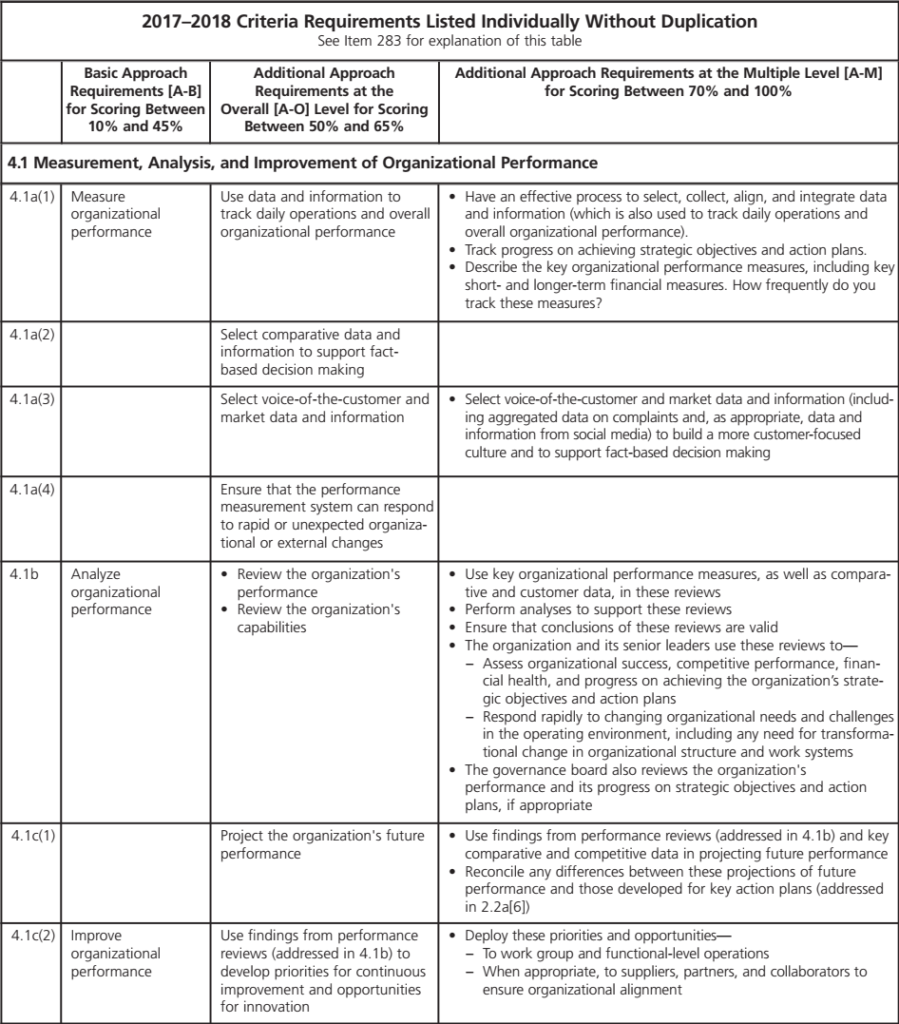
4.1. The questions in this item are closely linked to each other and to other Education Criteria items. The following are examples of key linkages:
• Your organizational performance measurement (4.1a)—including the comparative data and information you select, and the performance measures you report in your Criteria item responses—should inform your organizational performance reviews (4.1b).
• Organizational performance reviews (4.1b) should reflect your strategic objectives and action plans (category 2), and the results of organizational performance analysis and review should inform your strategy development and implementation, priorities for improvement, and opportunities for innovation (4.1c).
• Your performance projections for your key action plans should be reported in 2.2a(6).
• Your organizational performance results should be reported in items 7.1–7.5.
4.1a. Data and information from performance measurement should be used to support fact-based decisions that set and align organizational directions and resource use at the work unit, key process, department, and organization levels.
4.1a(2). The comparative data and information you select should be used to support operational and strategic decision making. Comparative data and information are obtained by benchmarking and by seeking competitive comparisons. Benchmarking is identifying processes and results that represent best practices and performance for similar activities, inside or outside the education sector. Competitive comparisons relate your performance to that of competitors and other organizations providing similar programs and services.
4.1a(3). Agility in your measurement system might be necessary in response to regulatory changes, other changes in the political or societal environment, disasters and emergencies, innovations in organizational processes or business models, or new competitor offerings. Responses to such changes might involve, for example, adopting different performance measures or adjusting the intervals between measurements.
4.1b. Performance analysis includes examining performance trends; organizational, education sector, and technology projections; and comparisons, cause-effect relationships, and correlations. This analysis should support your performance reviews, help determine root causes, and help set priorities for resource use. Accordingly, such analysis draws on all types of data: student learning; student- and other customer related; budgetary, financial, and market; operational; and competitive/comparative. The analysis should also draw on publicly mandated measures, when appropriate, and might also be informed by internal or external Baldrige assessments. Analysis may involve digital data analytics and data science techniques that detect patterns in large volumes of data (“big data”) and interpret their meaning.
4.1b. Rapid response to changing organizational needs and challenges may include responding to the need for change in your organizational structure and work systems.