Criterion 1 – Expected Learning Outcomes
Criterion
Requirements
Quality level assessment

Result
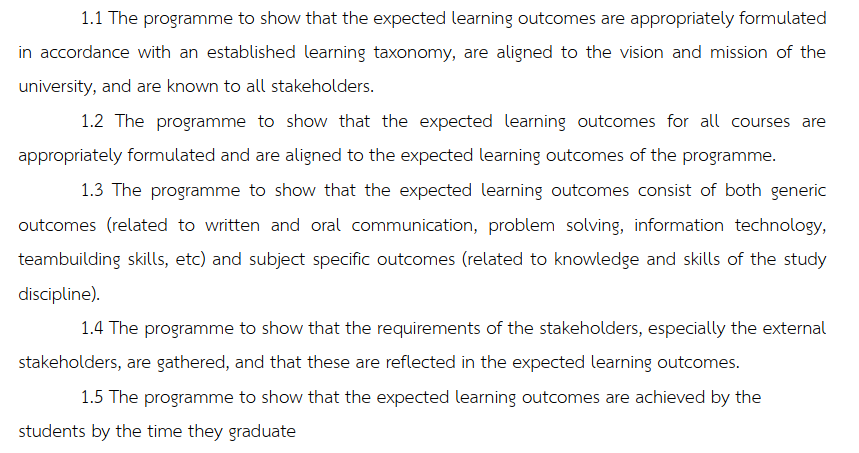
1.1 The programme to show that the expected learning outcomes are appropriately formulated following an established learning taxonomy, are aligned to the vision and mission of the university, and are known to all stakeholders.
Operational Result
St Teresa International University was established in 2001 as the first private international university in Nakhon Nayok. It aimed to provide international education using the English language as the medium of instruction because it aimed to be known in the country and worldwide. It accepts international and Thai students. Today, the university commits itself to being known globally. St Teresa International University envisions itself as a leading university that is acknowledged and accepted nationally and internationally. In addition, the mission stipulates that the university will :
- Produce graduates with high academic achievement and English language proficiency,
- Develop research and academic works that are acknowledged and recognized nationally and internationally.
- Develop a Center of Excellence for Academics, Professional Development, and English Language Competency.
- Preserve Thai and International arts and culture to form a coexisting multi-cultural society.
- Employ an administrative system that achieves excellence in organizational management.
Faculty of Education Mission and Objectives:
The mission is to produce graduates who can:
1. Research, analyze, and disseminate knowledge that contributes to the academic community.
2. Provide academic services for the educational development of the local and international communities. 3. Promote cultural arts with learning and teaching integrations
.4. Excel in the field of education according to the national standard criteria.
Philosophy of the Master’s in Education in Learning Management
Create leaders in learning management science, focusing on innovation
The program’s expected learning outcomes are stipulated in TQF 2. The program objectives (Generic learning outcomes) are communicated through the website so that all stakeholders will know the objectives of the program, and these objectives are translated into the learning outcomes of each course. The expected learning outcomes are communicated to students before the beginning of the semester via the learning plan of the instructor . Students know the objectives of their program. Students are informed and guided on how to manage their learning. However, there is a need to improve on this aspect so that all teaching instructors would implement the formulation of the course learning outcomes in consonance with the program objectives. If all instructors prepare the TQF 3 properly and on time, they can communicate the learning outcomes to the students at the beginning of the term. This can also be done by preparing a syllabus to be released to students. Google Classroom is an avenue to communicate the course learning outcome so that students will be able to manage their learning process by following what is expected of them.
However, communication of the learning outcome to the OHEC, now renamed the Ministry of Higher Education, Research, and Innovation, and the Teachers’ Council, was done when TQF 2 was submitted for approval. The program needs to have a process wherein other stakeholders, such as administrators of schools, private and public should be able to know the learning outcomes of the program, and their ideas on the revision of the program’s learning outcome development in the future may be included depending on the needs of the education sector where the students are working. Table 1 shows the mapping of the vision and mission of St Teresa International University with the mission of the Faculty of Education and MEd Learning Management Science.
The MEd learning management program objectives are formulated, and that is the basis of formulating the program learning outcomes, which in turn become the basis of formulating the course intended learning outcome, which is stipulated in TQF2 ( curriculum mapping). The department head monitors the matching of the formulation of the specific learning outcomes in TQF 3 . The TQF3 learning outcomes align with the stipulated learning outcomes in the TQF2. The course learning outcomes also align with the program learning outcomes. Better guidance in the attainment of the learning outcomes by students because they have a guide on what attributes they will acquire after finishing the course and the program
Table 1 . Alignment of the Vision, Mission of the University with the Faculty of Education and the Master of Education in Learning Management Science Generic LOs and Specific learning Outcomes.
| Vision St Theresa International University intends to be a leading university that is acknowledged and accepted nationally and internationally. | University Mission | Faculty of Education Mission | Philosophy of the Program | Program Generic Learning Outcomes | Program Specific Learning Outcomes |
| Produce graduates: | Produce graduates who can: | Create Leaders in Learning Management Science toward the innovative design of the teaching profession | Produce graduates who : | ||
| With high academic achievement and English language proficiency. | S1 exhibit language skills for communication and supervision to develop others | ||||
| Can develop research and academic works that are acknowledged and recognized nationally and internationally. | Research, analyze, and disseminate knowledge that contributes to the academic community. | Have knowledge and research skills and the ability to apply research to develop learning management | S 2 apply digital skills to support learning management and operations | ||
| With excellence in Academics, Professional Development, and English Language Competency? | Provide academic services for the educational development of the local and international communities. | can design a variety of learning management innovations in line with the need to develop learners at all levels and ages | S1 exhibit language skills for communication and supervision to develop others Att1 exhibit Well-being and academic leadership Att2 show Kindness and generosity to students and fellow professionals Att3 practice Responsibility and Commitment to developing learning management Att4 respect the rights of children and others | ||
| Can preserve Thai and International arts and culture to form a coexisting multicultural society. | Promote cultural arts with learning and teaching integrations. | E1 practice Teacher Professional Ethics E2 apply ethics of a Good Academic Leader Att4 respect the rights of children and others Att2 show Kindness and generosity to students and fellow professionals | |||
| Employ an administrative system that achieves excellence in organizational management. | Excel in the field of education by the national standard criteria. | are academic leaders in learning management science with morality, ethics, professional ethics, and adherence to the principles of good governance in operations | K1-acquire knowledge in Learning Management Science and Learning Management Technology era K2 analyze situations and apply appropriate knowledge and it is possible in the context of educational institutions and educational organizations |
| Table 2. Map of the Program Learning Outcomes According to Bloom’s Taxonomy of Med -LMS Vis -a-vis the Ministry of Higher Education Standard (Wix.com website, Faculty of Education) | ||||
| According to Bloom’s Taxonomy | Moral and Ethics | Knowledge or cognitive skill | Personal characteristics | skills |
| Understanding | Table 2. Map of the Program Learning Outcomes According to Bloom’s Taxonomy of Med -LMS Vis -a-vis the Ministry of Higher Education Standard (Wix.com website, Faculty of Education) | |||
| Applying | Att1: exhibit Well-being and academic leadership Att2 show Kindness and generosity to students and fellow professionals Att3: Practice Responsibility and Commitment to developing learning Management Att4: Respect the rights of children and others | K2: analyze situations and apply appropriate knowledge, which is possible in the context of educational institutions and educational organizations | K1: Acquire knowledge in Learning Management Science and the Learning Management Technology era | Att1: exhibit Well-being and academic leadership Att2 show Kindness and generosity to students and fellow professionals Att3: Practice Responsibility and Commitment to developing learning Management Att4: Respect the rights of children and others |
| Evaluating | Att1: exhibit Well-being and academic leadership Att2 show Kindness and generosity to students and fellow professionals Att3: practice Responsibility and Commitment to developing learning Management Att4: Respect the rights of children and others | |||
| Creating | K3: Create new options to develop learning management | S4: Create new knowledge in learning management | ||
1.2 The programme to show that the expected learning outcomes for all courses are appropriately formulated and are aligned to the expected learning outcomes of the programme.
TQF3 of the courses shows the formulated learning outcomes in relation to the program learning outcomes. Program instructors prepare the TQF 3; monitors, such as the department head and the dean, ensure the alignment of the course learning outcomes with the program learning outcomes before approving the TQF 3.
If the monitors observe disalignment, they return the TQF 3 with comments, and the lecturers will revise according to the course description. Revisions are done before transmittal, and then the program head approves the TQF3.
| S4 -Digital technology skills for life | |
| The Focused PLOs | Course Learning Outcomes |
| Search for solutions for problem behaviours in their classrooms | Knowledge about Psychology for learning to develop learning as follows: Students can; 1. Understand the nature and principles of growth and development, and give more input on different stages of development. 2. Understand the nature and types of individual differences among children and have a working knowledge of strategies and techniques for helping children. 3. Understand the nature and process of learning and the factors which facilitate or obstruct the learning process. 4. Discuss different psychological theories of learning. 5. Explain the nature of group structure and dynamics as relevant to classroom management. |
| K03: Knowledge and ability to apply knowledge for the development of life and the teaching profession | S-3 Teamwork and coordination skills |
| K04: Knowledge and ability to analyze, evaluate, and create new alternatives for living and developing the teaching profession: | Analyze classroom situations where psychological theories and principles are applied and find solutions to problems encountered |
| S1- Self-directed skill for finding knowledge | Search for solutions for problem behaviors in their classrooms |
| S2- Communication skills | Present their outputs in front of the class |
| Search for solutions for problem behaviours in their classrooms | Work harmoniously in a team doing assigned projects |
| S4 -Digital technology skills for life | S4 -Digital technology skills for life |
1.3 The programme to show that the expected learning outcomes consist of both generic outcomes (related to written and oral communication, problem solving, information technology, teambuilding skills, etc) and subject-specific outcomes (related to knowledge and skills of the study discipline).
Operational Result
The Master of Education in Learning Management Science program at ST. Teresa International University demonstrates a well-balanced structure of Expected Learning Outcomes (ELOs) that include both generic competencies and subject-specific expertise aligned with the national framework and global education standards.
Generic Learning Outcomes
The program promotes the development of essential generic skills that enhance employability and professional growth across various educational contexts. These outcomes are embedded across all courses and learning activities:
- Communication Skills (S02):
Students develop written and oral communication skills in both Thai and English through academic writing, class presentations, and collaborative discussions. - Problem Solving and Critical Thinking (C02, S01):
Analytical skills are emphasized through assignments, case studies, and action research projects requiring students to design educational interventions. - Digital Literacy (S04):
Students gain proficiency in educational technology tools, online teaching platforms, and digital resource management. - Teamwork and Collaboration (S03):
Group projects, peer-teaching sessions, and school-based practicum experiences foster collaboration and leadership. - Professional Attitudes (C03, C05):
The program cultivates confidence, creativity, responsibility, and a positive attitude toward change and innovation.
Subject-Specific Learning Outcomes
These outcomes ensure students acquire core disciplinary knowledge and skills relevant to the field of learning management:
- Pedagogical Knowledge and Application (K01–K04):
Courses focus on theories of learning, curriculum development, assessment methods, and classroom management strategies. - Instructional Design and Learning Support (S05):
Students are trained to create learner-centred environments, differentiate instruction, and apply inclusive teaching strategies. - Research and Inquiry Skills (S06):
The program requires a research-based thesis or independent study, enabling students to investigate real-world educational issues. - Ethical and Professional Standards (E01–E02):
Ethics and legal standards are integrated across subjects to ensure graduates act following professional codes and cultural values.
Conclusion
The curriculum design and implementation of the M.Ed. (LMS) The program successfully demonstrates alignment with both generic and subject-specific outcomes. These learning outcomes are explicitly stated, measurable, and continuously assessed through coursework, fieldwork, presentations, and research outputs.
As a result, graduates of the program are:
- Competent in advanced knowledge and practice in learning management
- Equipped with transferable skills for leadership and collaboration
- Ethical, responsible, and technologically adept educators
1.4 The programme is to show that the requirements of the stakeholders, especially the external stakeholders, are gathered, and that these are reflected in the expected learning outcomes.
Operational Result
Based on the standard of the Ministry of Higher Education, Research and Innovation, the designed learning outcomes appropriate to learning management are shown in the TQF3. The lecturers assigned to a course prepare the TQF3, ensuring the learning outcomes are achieved by the students in every topic listed in the course. The lecturer should ensure that the 4 aspects of knowledge, skills, morals and ethics, and personal characteristics are included in the list, which serves as a guide in the teaching, learning, and assessment process.
The TQF 3, which shows the plan for the course, will be submitted, and an assigned monitor will check the intended learning outcomes to see if they match the program outcomes and the course description. The assigned monitor will suggest any revisions if there seems to be a need to revise. After revisions, the TQF3 is approved and can now be used by the lecturer as a teaching guide throughout the term. The program managers check and approve TQF 3, where the teaching plan is inputted. Google classrooms with the syllabus are also prepared to be released to students. All lecturers need to link their course learning outcomes to the program learning outcomes
The requirements, comments and suggestions of stakeholders were taken into account and included in the revision of our new curriculum.
The revision of the Master of Education in Learning Management Science (M.Ed. LMS) curriculum was guided by the active engagement of key stakeholders—educational leaders, employers, alumni, faculty members, policymakers, and students—whose feedback was systematically collected, analyzed, and incorporated. The revised curriculum also reflects a strategic alignment with emerging trends in global education, quality assurance standards, and the transformative demands of the 21st-century teaching profession.
- Curriculum Modernization for Educational Disruption and Innovation
- Stakeholder Need: Graduates must be prepared to teach and lead in rapidly changing learning environments.
- Action Taken: Curriculum modules have been revised to incorporate future-ready content, including learning analytics, AI in education, adaptive learning technologies, and instructional design for hybrid classrooms. These updates reflect benchmarks from internationally ranked institutions and support Learning Outcome S04 (Digital Technology Skills).
2. Increased Relevance to Local Contexts and Global Competence
- Stakeholder Need: Relevance to Thai education systems while remaining globally competitive.
- Action Taken: The curriculum embeds Thai education policies and multicultural awareness, while simultaneously developing global citizenship, bilingualism (Thai–English), and cross-cultural communication. This is aligned with ASEAN teacher standards and UNESCO’s Global Education Monitoring (GEM) goals.
3. Robust Research Capability and Applied Inquiry
- Stakeholder Need: Graduates with the capacity to conduct impactful educational research.
- Action Taken: A redesigned research core includes Action Research for School Improvement, Seminars on Learning Innovation, and a Thesis that must lead to academic publication or dissemination. This addresses S06 (Research Skills) and ensures the program produces research-literate and reflective educators.
4. Leadership, Ethics, and Professional Standards
- Stakeholder Need: Leadership capacity grounded in ethics and moral reasoning.
- Action Taken: Professional ethics, educational leadership, and reflective practice are interwoven throughout the curriculum. Emphasis is placed on E01–E02 (Ethical Practices) and C03 (Academic Leadership), aligned with the Teachers’ Council of Thailand Code of Ethics and UNESCO Teacher Professionalism Framework.
5. Progressive Curriculum Structure and Learning Pathways
- Stakeholder Need: A coherent, flexible, and progression-based curriculum structure.
- Action Taken: The curriculum is logically sequenced—from foundational theories and practices to specialized and applied knowledge. Elective pathways allow learners to pursue areas such as STEM learning, inclusive education, and innovative pedagogies. These changes ensure alignment with Thailand Qualifications Framework (TQF) and allow for personalized learning trajectories.
6. Bilingual Communication and Team Collaboration
- Stakeholder Need: Strong communication and teamwork in professional, bilingual contexts.
- Action Taken: All students are engaged in bilingual learning environments with collaborative projects, seminars, and reflective peer assessments to build S02 (Communication Skills) and S03 (Teamwork and Coordination Skills). Communication in Thai and English is integrated into course delivery, assessment, and reporting processes.
7. Real-World Learning and Professional Networking
- Stakeholder Need: Exposure to real school environments and professional communities.
- Action Taken: Through School-University Partnerships, practicum placements, and regular interaction with professional learning communities (PLCs), students engage in context-based learning and develop practical instructional and leadership competencies in authentic educational settings.
The M.Ed. in Learning Management Science curriculum at STIC now reflects a high level of stakeholder-responsive, evidence-based, and forward-thinking design. With a balanced integration of local relevance, international outlook, academic rigour, and future readiness, the program is positioned to produce highly competent, ethical, and visionary educational leaders prepared to meet national and global educational challenges.
1.5 The programme is to show that the expected learning outcomes are achieved by the students by the time they graduate.
Operational Result
At the moment, there are no graduates of the program. However, the program will monitor the achievement of the learning outcome of the graduate by surveying the graduate in their workplace. Interview with the employers of the students to follow up on the performance of the graduates. The survey form was used to survey future graduates’ performance on the different categories of learning outcomes. The survey form also contains the graduates’ performance at their workplaces.
Table 3: Expectation of the Achievement of the Learning Outcomes at the end of each year. ( TQF 2)
Evidence
| ID_Evidence | Name_Evidence |
| 1.1-1 | TRSU, Website shows the Vision and Mission https://www.stic.ac.th/about-the- university |
| 1.1-2 | MEd LM Website: https://www.stic.ac.th/postgraduate-program/learning-management |
| 1-1.-3 | MEd LM Website 2 https://drsuphak.wixsite.com/graduateschooledstic/copy-of-grad-dip-english |
| 1-1-4 | Sample Syllabus to show mapping of program outcomes with course outcomes: https://drive.google.com/file/d/1zOL4Zv0wHcsdza7Dv7YpEP0JPVSf7H0_/view?usp=sharing |
| 1.2 | TQF 3: https://mis.stic.ac.th/teacher/tqf.php?ay=2565&sm=2&cs=1515&pg=MLM&oc=431&tqf=3&Teacher_code=462& |
| 1.2-1 | CLOs align with PLOs |
| 1.4 | Stakeholders Suggesstion Form |
| 1.5 | Student Outcome and Monitoring System Verification of Learning Outcomes Achievement Course Evaluation Report |
Self-Assessment
| Requirements | Result | Score |
| 1.1 The programme to show that the expected learning outcomes are appropriately formulated in accordance with an established learning taxonomy, are aligned to the vision and mission of the university, and are known to all stakeholders. | / | 1 |
| 1.1 The programme to show that the expected learning outcomes are appropriately formulated following an established learning taxonomy, are aligned to the vision and mission of the university, and are known to all stakeholders. | / | 1 |
| 1.4 The programme is to show that the requirements of the stakeholders, especially the external stakeholders, are gathered, and that these are reflected in the expected learning outcomes. | / | 1 |
| 1.3 The programme is to show that the expected learning outcomes consist of both generic outcomes and subject-specific outcomes. | / | 1 |
| 1.5 The programme to show that the expected learning outcomes are achieved by the students by the time they graduate | / | 1 |
| Overall | 5 | |