Criterion 2 – Programme Structure and Content
Criterion
Requirements
Quality level assessment

Result
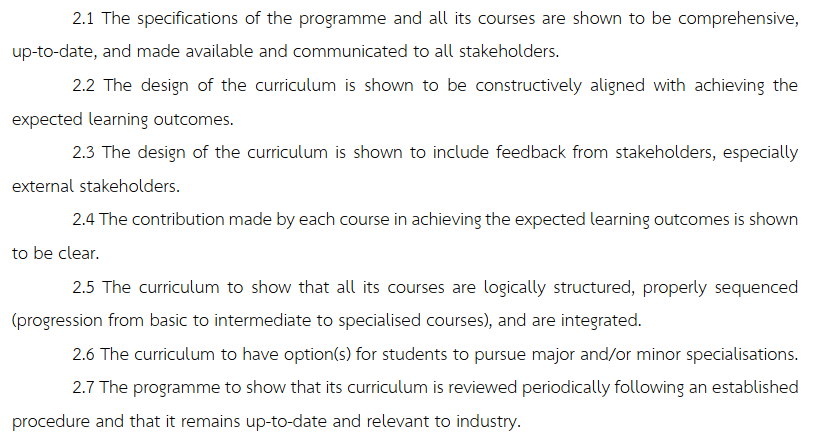
2.1 The specifications of the programme and all its courses are shown to be comprehensive, up-to-date, and made available and communicated to all stakeholders.
Operational Result
The specifications of the program and all its courses are comprehensive, up-to-date, and effectively communicated to all stakeholders. We have implemented several measures. Each course has a detailed syllabus, and a comprehensive program handbook is made available, outlining the overall structure, course sequences, and goals. We conduct annual reviews of course content and gather feedback from students, faculty, partner schools, and alumni to ensure relevance and currency. All updated program specifications and course details are accessible on our institution’s website and learning management systems, and printed materials are provided during orientation and in the library. Regular advisory sessions and information workshops are held to explain program details and updates. Additionally, we maintain transparent processes by publishing annual reports on curriculum updates and organizing open forums for stakeholder discussions. This comprehensive approach ensures that all stakeholders are well-informed and engaged with the latest program developments
The steps below demonstrate that the specifications of our program and all its courses are comprehensive, up-to-date, and communicated to all stakeholders:
- Detailed Documentation: Comprehensive and Up-to-Date Course Specifications:
- Course Outlines: Courses have a detailed syllabus that includes objectives, learning outcomes, content, teaching methods, and assessment methods.
- Program Handbook: There is a program handbook that outlines the overall structure, course sequences, and program goals.
- Regular Review and Updates: Regular Review Process:
- Annual Reviews: There are annual reviews of course content and program structure to ensure they remain current and relevant.
- Stakeholder Feedback: Feedback from students, faculty, industry partners, and alumni is gathered.
- Clear Communication Channels: Information Availability and Communication
- Online Platforms: All program specifications and course details are available on the institution’s website and learning management systems.
- Printed Materials: Printed handbooks and course guides during orientation and in the library.
- Advisory Sessions: Regular advisory sessions and meetings where stakeholders can discuss and understand course specifications.
- Engagement with Stakeholders: Involvement of all Stakeholders
- Information Sessions: Meetings are held to explain program details and updates to students and faculty.
- School Partners: Consultation with partner school to ensure the program aligns with current professional standards and practices.
- Alumni Network: Use feedback from the alumni network to adjust and improve the curriculum.
With these steps, we ensure that the program and its courses are comprehensive, up-to-date, and effectively communicated to all stakeholders. This approach not only meets the requirement but also enhances the overall quality and transparency of our program.
2.2 The design of the curriculum is shown to be constructively aligned with achieving the expected learning outcomes.
Operational Result
The B.Ed.-Science curriculum is meticulously designed to produce professional teachers equipped with exceptional science skills, well-rounded knowledge, strong character, integrity, honesty, and lifelong learning skills. To achieve this, we have established a robust alignment of our Program Learning Outcomes (PLOs), Year Learning Outcomes (YLOs), and Course Learning Outcomes (CLOs) with our Learning Management strategies. Lecturers are required to adapt to new changes and technologies in teaching, especially during the post-pandemic era, which has accelerated the adoption of innovative tools such as Google Classroom, Google Meet, and the MIS System. These platforms facilitate interactive and effective online learning, ensuring continuous engagement and academic progress.
Each course within the program is mapped to specific PLOs, ensuring that every aspect of the curriculum contributes directly to the overarching goals of the program. For example, science courses focus on developing scientific mind, while pedagogical courses emphasize teaching methodologies, classroom management, and educational psychology. Regular assessments, both formative and summative, are integrated into the curriculum to monitor and evaluate student progress against these outcomes.
Furthermore, we conduct periodic curriculum reviews and stakeholder consultations, including feedback from students, alumni, and industry partners, to ensure the program remains relevant and effective. This process includes analyzing assessment data, student performance, and feedback to identify areas for improvement and to make necessary adjustments.
By strategically aligning the curriculum with the expected learning outcomes, we ensure that our graduates are not only academically proficient but also possess the professional and ethical attributes required to excel as educators. This comprehensive approach guarantees that our students meet the expectations of various stakeholders, including educational institutions, employers, and the broader community, by the time they graduate.
2.3 The design of the curriculum is shown to include feedback from stakeholders, especially external stakeholders.
Operational Result
Participation of stakeholders is a crucial factor in the design, revision, and implementation of our curriculum. The curriculum development process actively incorporates feedback from a diverse group of stakeholders, especially external stakeholders, including professional organizations and employers. We regularly assess the achievement of our program’s objectives and conduct comprehensive surveys to gather insights from these stakeholders. Their input is invaluable in ensuring our curriculum remains relevant and effective.
We also take into account global trends in Science Teaching when developing or revising our curriculum. This includes analyzing opportunities and threats to ensure our graduates are well-prepared for the ever-evolving Science Teaching trends. Regular feedback sessions, focus groups, and advisory board meetings are conducted to discuss and integrate stakeholder perspectives.
This collaborative approach allows us to align our educational offerings with school needs and expectations, thereby enhancing the employability and professional readiness of our graduates. Through these efforts, we ensure that our curriculum not only meets academic standards but also addresses the practical requirements of the schools.
2.4 The contribution made by each course in achieving the expected learning outcomes is shown to be clear.
Operational Result
All the contribution made to each course in achieving expected learning outcomes is clear. To demonstrate that each course’s contribution to achieving the expected learning outcomes is clear, we have implemented several key practices.
- Course Mapping: Each course syllabus includes a mapping section that outlines how the course contributes to the program’s learning outcomes (PLOs), with specific course learning outcomes (CLOs) aligned with PLOs and Year Learning Outcomes (YLOs).
- Detailed Course Rubrics: We use detailed rubrics for assignments and exams to highlight which learning outcomes are being assessed, ensuring transparency for students and instructors.
- Curriculum Reviews: Regular curriculum review meetings with faculty and feedback from students, alumni, and external stakeholders help ensure that courses are effectively aligned with learning outcomes.
- Course Portfolios: Detailed course portfolios that document how each course contributes to the learning outcomes. These portfolios include syllabi, assessment samples, and summaries of student performance data.
- Communication to Students: During student orientation and advising sessions, we communicate the alignment of courses with program learning outcomes, and course guides explicitly link activities and assessments to these outcomes.
These comprehensive practices ensure that the contribution of each course to achieving the learning outcomes is clear and well-documented, providing transparency and accountability in our program.
2.5 The curriculum to show that all its courses are logically structured, properly sequenced (progression from basic to intermediate to specialised courses), and are integrated.
Operational Result
The LMS program at STIC is designed with a logically structured and properly sequenced curriculum that progresses from foundational knowledge to specialized expertise.
- Foundational Courses:
Students begin with core courses that establish a strong base in educational theories and learning management principles. - Intermediate Courses:
Building upon the foundation, intermediate courses delve into curriculum development, instructional design, and assessment strategies. - Specialized Courses:
Advanced courses focus on specialized topics such as educational leadership, technology integration, and research methodologies. - Integration and Application:
The curriculum culminates in a research project or thesis, allowing students to apply their learning in practical settings, demonstrating the integration of knowledge and skills acquired throughout the program.
This structured progression ensures that students develop comprehensive competencies in learning management science, preparing them for leadership roles in educational settings.
2.6 The curriculum to have options for students to pursue major and/or minor specialisations.
Operational Result
The Master of Education in Learning Management Science program at ST Teresa International University is designed with curricular flexibility and academic depth to meet diverse professional goals. Although the program does not officially categorize its curriculum into formal majors or minors, it incorporates concentration pathways and elective courses that enable students to pursue specialized interests in line with their career trajectories.
1. Curriculum Structure with Specialization Pathways
The program comprises:
- Compulsory Core Courses (Fundamental knowledge for all students)
- Elective Courses (Student-chosen for interest-based or skill-based specialization)
- Research Component/Thesis or Independent Study (Allows deeper specialization)
Students can select elective courses that align with areas of specialization such as:
- Educational Leadership and Administration
- Instructional Design and Curriculum Development
- Digital Learning and Educational Technology
- Assessment and Evaluation in Education
- Research in Learning and Instruction
This structure allows students to customize their academic journey toward specific competencies without being restricted to a rigid track.
2. Research and Thesis as a Specialization Tool
The thesis or independent study project component of the LMS program gives students the opportunity to:
- Select a research topic in a specific area of interest
- Work under expert faculty supervision
- Develop mastery and produce scholarly work relevant to their focus area
This mechanism serves as a specialization outlet and is considered a key component in shaping a graduate’s academic identity and applied skills.
3. Academic Advising and Support
Students are guided by advisors who help them:
- Choose elective courses that complement their academic and career goals
- Plan their thesis or independent project according to specialization interest
- Ensure alignment with the Program Learning Outcomes (PLOs)
4. Integration with National and International Educational Trends
The elective offerings and specialization focus areas are continuously reviewed and aligned with:
- Educational policies
- Labor market needs
- Emerging trends in learning sciences and digital pedagogy
This ensures relevance and future-readiness of the graduates.
Conclusion
While the M.Ed. (LMS) program does not offer formally declared “majors” or “minors,” it effectively allows specialization through:
- Elective course selection
- Personalized research projects
- Flexible curriculum planning
This structure provides a balanced combination of structure and freedom, enabling students to emerge as experts in their chosen educational field while fulfilling the core objectives of the graduate program.
We have established partnerships with numerous local and international universities, enhancing the educational experience by providing a wide range of choices and opportunities for our students. These partnerships enable students to gain global perspectives, access diverse academic resources, and experience different educational environments. Our collaborations with esteemed institutions around the world ensure that our students receive a well-rounded and internationally recognized education.
2.7 The programme to show that its curriculum is reviewed periodically following an established procedure and that it remains up-to-date and relevant to industry.
Operational Result
The faculty’s curriculum development process is thorough and inclusive, incorporating input from various stakeholders to ensure its relevance and effectiveness. Committees tasked with curriculum development consist of experts from both inside and outside the university, bringing diverse perspectives and industry insights to the table. These committees meticulously review and update the curriculum based on the college’s established criteria, including its philosophy, objectives, structure, and course content standards.
The curriculum development process is guided by rigorous standards and criteria to meet the ever-evolving demands of the education sector. Committee members collaborate to design a curriculum that not only meets these standards but also reflects current trends and best practices in Science Teaching. Additionally, they manage the curriculum documents, ensuring that they are accurate, up-to-date, and easily accessible to faculty and students.
For instance, the recent approval of the new curriculum for the B.Ed. Program in Science Teaching, set to be fully implemented in June 2024, is a testament to the faculty’s commitment to maintaining high standards of education. This ongoing review and revision process demonstrates the faculty’s dedication to providing students with a curriculum that is not only academically robust but also relevant to the needs of the industry.
Evidence
Self-Assessment
| Requirements | Result | Score |
| 2.1 The specifications of the programme and all its courses are shown to be comprehensive, up-to-date, and made available and communicated to all stakeholders. | / | 1 |
| 2.4 The contribution made by each course in achieving the expected learning outcomes is shown to be clear. | / | |
| 2.2 The design of the curriculum is shown to be constructively aligned with achieving the expected learning outcomes. | / | 1 |
| 2.3 The design of the curriculum is shown to include feedback from stakeholders, especially external stakeholders. | / | |
| 2.5 The curriculum to show that all its courses are logically structured, properly sequenced and integrated. | / | 1 |
| 2.6 The curriculum to have option(s) for students to pursue major and/or minor specialisations. | / | 1 |
| 2.7 The programme to show that its curriculum is reviewed periodically following an established procedure and that it remains up-to-date and relevant to industry. | / | 1 |
| Overall | 5 | |