Criterion 3 – Teaching and Learning Approach
Criterion
Requirements
Quality level assessment

Result
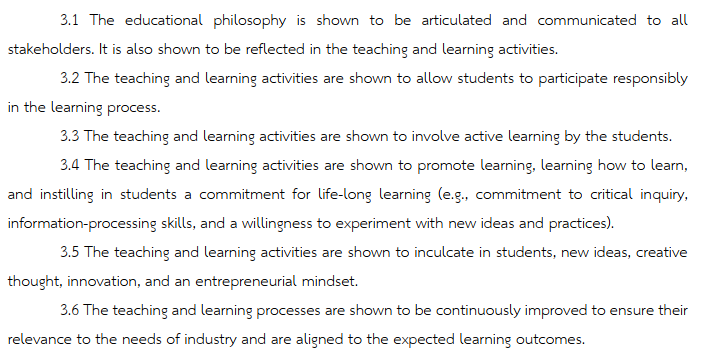
3.1 The educational philosophy is shown to be articulated and communicated to all stakeholders. It is also shown to be reflected in the teaching and learning activities.
Operational Result
The Faculty’s Education Philosophy is articulated and communicated to all stakeholders through multiple channels to ensure a shared understanding and commitment to our mission. Below is the Faculty’s Educational Philosophy, which is disseminated to all stakeholders.
Philosophy: Producing knowledgeable teachers and educational personnel who possess academic and professional skills, as well as strong morality, ethics, and professional ethics. Our aim is to develop teachers and educational personnel who are eager to learn, disciplined, kind, and responsible, contributing to both local development and the country in general.
For the Bachelor of Education in English (BEd-English) Program, the focus is on developing the essential skills and expertise required in the profession of teaching English. This is achieved through a comprehensive curriculum that integrates knowledge in innovation, information technology, modern educational materials, and effective classroom management. The program emphasizes practical experience and theoretical knowledge, ensuring that students are well-prepared for the dynamic demands of the teaching profession.
The Faculty’s Educational Philosophy is communicated to stakeholders through various platforms, including official websites, brochures, orientation programs, and stakeholder meetings. Regular newsletters and updates are sent to keep stakeholders informed about the latest developments and how the philosophy is being implemented. Additionally, Professional Learning Community (PLCs) are held where faculty, students, and external partners discuss the philosophy and its application in the educational setting. Stakeholder feedback is actively sought and used to refine and improve the communication strategy.
Integration in Teaching and Learning Activities: The Educational Philosophy is integrated in the teaching and learning activities of the BEd-English Program. Courses are designed to integrate innovative teaching methods, information technology, and Modern trends in English Language Teaching and Assessments. Classroom management skills are developed through practical workshops and real-world teaching practicums. Students engage in activities that promote ethical behavior and professional conduct, such as case studies, role-playing, and discussions on ethical dilemmas.
Moreover, the program includes a variety of extracurricular activities aimed at fostering a commitment to local development through various projects by the program. These include community service projects, internships in local schools, and collaborative projects with educational institutions and local communities. Students are encouraged to participate in professional development seminars and conferences to stay abreast of the latest trends and practices in English language teaching.
Through this holistic approach, the program ensures that graduates are not only proficient in their academic and professional skills but also embody the moral and ethical standards outlined in the Faculty’s Educational Philosophy.
Evidence
| ID_Evidence | Name_Evidence |
| 3.1-1 | Philosophy of the Program (TQF 2) |
| 3.1.2 | Philosophy, Vision and Mission of the Program ( Website) |
| 3.1-3 | Lecturer’s Teaching Manual |
3.2 The teaching and learning activities are shown to allow students to participate responsibly in the learning process.
Operational Result
The program focuses on task and outcome-based as well as Work Integrated learning (WIL)wherein students are responsible for their own learning. This means that our students are involved in the teaching and learning process every step of the way. Both academic and co-curricular activities involve students, which are aimed at helping them advance academically, socially, nationally, and internationally.
Active Student Participation: Students are encouraged to take an active role in their learning by participating in setting personal learning goals and engaging in self-assessment and peer-assessment activities through our faculty wide project, Student Portfolios. This fosters a sense of ownership and responsibility for their own learning. In 2024, students actively participated in various teaching and learning activities aimed at promoting English language skills and educational engagement.
- Academic Expo – Course Output Exhibit
During the Academic Expo, students showcased the outcomes of different courses through creative displays, interactive presentations, and performances. These exhibits highlighted their learning progress, project work, and the practical application of English skills, reflecting both academic and personal growth.
2. English on Tour Project
The 3rd year students of the Faculty taking English Language Teaching 2, along with volunteers from different year levels, visited four different schools to teach for younger students. This activity allowed them to apply their language knowledge in real-life contexts, while also enhancing their communication, teamwork, and leadership skills.
3. English Camp – Ongkarak School
Students also organized and facilitated an English Camp for the students of Ongkarak School. Through engaging games, language-based activities, and cultural exchanges, they created a dynamic learning environment that encouraged confidence in using English among participants. The camp also fostered a sense of responsibility and empathy among the student volunteers.
Collaborative Projects: Students are involved in collaborative projects that require teamwork, communication, and problem-solving skills. These projects are often designed to address real-world issues, allowing students to apply their theoretical knowledge in practical settings.
Creativity and Innovation: The program promotes creativity and innovation by involving students in research projects, encouraging them to explore new ideas and contribute to the advancement of knowledge in their field. Our students’ outputs are showcased in our annual Academic Expo where students showcase their academic output across all courses.
Practical Training and Internships: Practical training and internships are integral parts of the program. Students gain hands-on experience in real educational settings, working under the guidance of experienced mentors. This not only enhances their practical skills but also builds their confidence and professionalism.
Student-Led Initiatives: Students are given opportunities to lead and organize various activities and events, such as workshops, seminars, and community service projects. These initiatives help students develop leadership and organizational skills while contributing to their communities.
Feedback and Continuous Improvement: Regular feedback sessions are conducted where students can voice their opinions on the curriculum, teaching methods, and overall program effectiveness. This feedback is taken seriously and used to make continuous improvements, ensuring that the program meets the needs and expectations of the students.
Global Citizen: The program includes opportunities for students to participate in exchange programs, international camps and cultural immersion experiences. These activities broaden their perspectives, enhance their cultural awareness, and prepare them to be a global citizen.
Evidence
3.3 The teaching and learning activities are shown to involve active learning by the students.
Operational Result
The program emphasizes active student engagement through student-centered activities, empowering learners to take an active role in both teaching and learning. Rather than being passive recipients of information, students are encouraged to create new knowledge and innovations. This is supported by cognitive (thinking) and social (group) processes that foster interaction and participation. In this approach, the teacher acts as a facilitator, aligning students’ interests, abilities, and skills with opportunities to integrate knowledge across various disciplines. A variety of teaching methods, knowledge sources, and assessment strategies are employed to support this integration.
Teaching strategies and evaluation methods are intentionally designed to promote active student involvement. These strategies are aimed at enhancing learning outcomes and achievements by encouraging students to participate meaningfully in the learning process. By applying their knowledge in real-world contexts, students engage more deeply and purposefully. Teachers are responsible for selecting instructional and assessment methods that align with student-centered principles and promote active, reflective learning.
A key component of the program is the integration of co-curricular activities across many courses, further encouraging student participation. Courses such as Children’s Literature, Teaching English through Drama, English Teaching & Learning, and Research for Learning Development incorporate co-curricular elements into their instruction. This ensures that students are fully engaged in the teaching and learning process, both inside and outside the classroom.
Evidence
| ID_Evidence | Name_Evidence |
| 3.3-1 | BEd English Student Centered Approach: Teaching-Learning Activities that Promote Active Learning |
| 3.3-2 | Active Learning Activities |
| 3.3. 3 | Student Led Activities |
3.4 The teaching and learning activities are shown to promote learning, learning how to learn, and instilling in students a commitment for life-long learning (e.g., commitment to critical inquiry, information-processing skills, and a willingness to experiment with new ideas and practices).
Operational Result
The Task-Based Learning and Work-Integrated Learning (WIL) approaches in the BEd English program are designed to foster meaningful learning, cultivate the ability to learn independently, and instill a strong commitment to lifelong learning. This commitment includes engaging in critical inquiry, sharpening information-processing skills, and embracing innovation by experimenting with new ideas and practices—preparing students to thrive in a constantly evolving world.
In alignment with the core missions of higher education, the program thoughtfully integrates coursework with research, community academic service, arts, and cultural engagement. These elements enrich the academic experience while nurturing a sense of responsibility in students to take ownership of their learning beyond the classroom. Throughout 2023, the program has actively embedded these components into the curriculum, ensuring that students gain not only knowledge but also the mindset and competencies essential for ongoing personal and professional growth.
Recognizing that valuable learning occurs beyond traditional classroom settings, the program emphasizes immersive, experiential learning opportunities. Students are encouraged to engage in activities that promote critical thinking, leadership, and teamwork—skills crucial for navigating real-world challenges. Additionally, the program prioritizes student participation in co-curricular activities, many of which are student-led. These experiences offer practical contexts for applying classroom knowledge, further reinforcing the program’s commitment to lifelong learning
Evidence
| ID_Evidence | Name_Evidence |
| 3.4-1 | BEd Guidelines on Classroom Activities that Promote Life-long Learning |
| 3.4.1 | Learning how to learn, Inquiry and lifelong learning Projects |
3.5 The teaching and learning activities are shown to inculcate in students, new ideas, creative thought, innovation, and an entrepreneurial mindset.
Operational Result
Our outcome-based learning approach is purposefully designed to develop students’ ability to generate new ideas, think creatively, innovate, and adopt an entrepreneurial mindset. The curriculum supports these goals through a range of teaching strategies and engaging activities.
The planning and design of instruction are grounded in key educational theories and principles, including Constructivism, Problem-Based Learning, Integration-Based Learning, progression from concrete to abstract, Authentic Learning, experiential learning, and both inductive and deductive reasoning. These frameworks are translated into practice through thoughtfully designed activities that challenge students to think innovatively and solve real-world problems.
Students are provided with diverse opportunities—such as project-based work, group collaboration, and hands-on learning experiences—that encourage exploration, experimentation, and the development of entrepreneurial thinking. These experiences not only deepen students’ understanding of subject content but also equip them with the critical skills and mindset needed to navigate a dynamic and rapidly evolving world.
A highlight of this approach is the Annual Education Expo, where students present their innovative projects, creative solutions, and entrepreneurial initiatives. This event serves as a platform to celebrate their achievements, while also inspiring them to continue thinking creatively, pursuing innovation, and exploring entrepreneurial opportunities.
Evidence
| ID_Evidence | Name_Evidence |
| 3.5-1 | BEd Program Student-Based Learning Strategy Guidelines: Teaching- learning activities that inculcate in students, new ideas, creative thought, innovation, and an entrepreneurial mindset. |
| 3.5-2 | Theory into Practice: Students Academic Output Showcase |
| 3.5.2 | Students Academic Output |
3.6 The teaching and learning processes are shown to be continuously improved to ensure their relevance to the needs of industry and are aligned to the expected learning outcomes.
Operational Result
The BEd curriculum and its teaching-learning approach are continuously reviewed and refined to ensure alignment with industry demands and the attainment of the program’s intended learning outcomes. Our instructional practices are strengthened through the integration of digital platforms such as Google Classroom and Moodle, which support effective delivery and enhance student learning experiences.
Evaluation Process
Both program administrators and students play a vital role in evaluating the teaching and learning process. They provide feedback on teaching methods, course content, and overall learning experiences, as well as assess instructor performance. This input is essential for identifying areas that need improvement and for refining teaching strategies. Instructors also engage in self-assessment to reflect on their practices and pinpoint areas for professional growth. Feedback from both students and faculty is instrumental in driving the ongoing enhancement of teaching quality.
Improvement Plan
As part of our commitment to continuous improvement, we implement the TQF 5 & 6 framework to evaluate teaching effectiveness and measure student learning outcomes. This framework helps us monitor student progress, recognize strengths and areas needing support, and apply targeted interventions to optimize learning. Through ongoing assessment and responsive enhancements, we ensure our teaching methods and curriculum remain dynamic, student-focused, and aligned with the highest standards of quality education.
Evidence
| ID_Evidence | Name_Evidence |
| 3.6-1 | TQF 5: Course Report and Improvement Plan |
| 3.6-2 | BEd Revised Curriculum |
Self-Assessment
| Requirements | Result | Score |
| 3.1 The educational philosophy is shown to be articulated and communicated to all stakeholders. It is also shown to be reflected in the teaching and learning activities. | / | 1 |
| 3.2 The teaching and learning activities are shown to allow students to participate responsibly in the learning process. | / | 1 |
| 3.3 The teaching and learning activities are shown to involve active learning by the students. | / | |
| 3.4 The teaching and learning activities are shown to promote learning, learning how to learn, and instilling in students a commitment for life-long learning. | / | 1 |
| 3.5 The teaching and learning activities are shown to inculcate in students, new ideas, creative thought, innovation, and an entrepreneurial mindset. | / | 1 |
| 3.6 The teaching and learning processes are shown to be continuously improved to ensure their relevance to the needs of industry and are aligned to the expected learning outcomes. | / | 1 |
| Overall | 5 | |